anti-lgbtq · homophobia · Sexuality · Social Justice

State-Sanctioned Violence Towards LGBTQ Young Adults

Excerpt from my paper: Examining the Impact of Anti-LGBTQ State-Sanctioned Violence on LGBTQ Young Adults and Responses in Scholarship to that Impact – A Review of Literature

Introduction

Culture affects how we view sex, and the ‘normalization’ of heterosexuality promotes a socially preferred performance of sexuality (Tonstad, 2018). A commonly held belief by many is that each person they meet is heterosexual – until proven otherwise. The sexual phobias of the few affect the sexual freedom of the many. This enforcement of heteronormative values upon sexual minorities has caused extensive damage to the emotional and spiritual health of the LGBTQ community. Bjork-James (2019) contends that we see conservative Christians coming from a perceived place of moral obligation to inflict state-sanctioned violence (SSV) which in turn fosters an environment that is unsafe and demeaning for the perceived sinful practices of LGBTQ individuals.

State-Sanctioned Violence

The proliferation of anti-LGBTQ state legislation can be seen as a form of SSV where the actions or inactions of a government agency or institution that either sanctions or ignores a population can have a negative impact. Bjork-James (2019) argues that white evangelicals have been working to oppose any LGBTQ rights since the 1970s with justification for this form of oppression being disguised as enforcement of morality, adhering to biblical teachings and not about hate. Bjork-James (2019) argues that conservative Christians claim no wrongdoing in their anti-LGBTQ actions, and they falsely expound their own victimhood due to the increase of civil rights for sexual minorities. Bjork-James (2019) points out that conservative Christians are defending these methods used to maintain a doctrine of heteronormativity by claiming their “criticism of LGBTQ rights is not rooted in personal animus” (p. 281). Bjork-James (2019) contends that conservative Christians’ imperative to maintain moral order in the United States comes from a false notion the country was founded as a Christian nation. As during the time of Anita Bryant, conservative Christians are justifying the increase in SSV today under the guise of ‘saving the children’ from the “homosexual agenda” (Bjork-James, 2019, p. 278).

Over the past decade numerous conservative state legislatures have debated and proposed numerous anti-LGBTQ bills. While many of these bills did not become law for various reasons, the fact they were debated can be seen as a form of SSV in how it affected the LGBTQ community. Cunningham et al. (2022) examine the relationship between anti-transgender rights legislation in state legislatures and the increase in internet searches related to suicide and depression. The article illustrates how an anti-transgender bill in Texas was only debated in committee and had a profound impact on the transgender community. While this bill was never voted on the floor of the Texas House, “reports from a suicide hotline indicate an almost doubling of calls from transgender youth during [that] time” (Cunningham et al., 2022, p. 2).  The qualitative research Cunningham et al. (2022) discuss illustrates there is a correlation between the passage or defeat of anti-transgender legislation and the increase of suicide-related searches or decrease in depression-related searches, respectfully.

The systemic nature of SSV has an impact on the larger LGBTQ community as well as individual members. The systemic attacks upon LGBTQ rights we are currently seeing in various part of the United States has increased the potential for individuals to experience violence, including death. Lund et al. (2021) illustrate the implicit and explicit violence perpetrated against members of the greater LGBTQ community, that is viewed as interpersonal and systemic violence, respectfully. Gebhard et al. (2022) “define [SSV] as government entities’ use of violence to control or punish; those entities’ turning a blind eye to violence; and criminal prosecution of those who attempt to defend themselves through intimidation, fear and threat to life” (p. 476). Gebhard et al. (2022) primarily focus on community resiliency in the face of SSV and illustrate how systemic oppression “has been a fixture of the country since its beginnings” (p. 476). Creating stigma of ‘the other’ helps to enlist support to perpetuate SSV from the dominant population. This support of ‘othering’ can also lead to the engagement of individuals to perpetuate this violence towards LGBTQ individuals.    

Cunningham et al. (2022) argue that conservative Christians use an illusion of being in the majority with power to inflict SSV through enactment of policies, legislation, and laws to maintain their constant message for the oppression, rejection, and stigmatization of LGBTQ people. Having one’s senses inundated daily that others see them as disgusting, as an abomination, or as a threat to society will have a negative impact, especially if that individual is a religiously-affiliated member of the LGBTQ community. Believing to be morally defective with feelings of guilt or shame about not living up to the higher standards of one’s family or community can begin to elicit an internalized tension that can become a spiritual struggle or religious trauma (Pargament, 2021).

___________________________________________________
Bibliography

Bjork-James, S. (2019). Christian Nationalism and LGBTQ Structural Violence in the United States. Journal of Religion and Violence, 7(3), 278–302. https://doi.org/10.5840/jrv202031069

Cunningham, G. B., Watanabe, N. M., & Buzuvis, E. (2022). Anti-transgender rights legislation and internet searches pertaining to depression and suicide. PLoS One, 17(12), e0279420. https://doi.org/10.1371/journal.pone.0279420

Gebhard, K. T., Hargrove, S., Chaudhry, T., Buchwach, S. Y., & Cattaneo, L. B. (2022). Building strength for the long haul toward liberation: What psychology can contribute to the resilience of communities targeted by state‐sanctioned violence. American Journal of Community Psychology, 70(3–4), 475–492. https://doi.org/10.1002/ajcp.12596

Pargament, K. I. (2021). Introducing Spiritual Struggles. In Working with spiritual struggles in psychotherapy: From research to practice (pp. 3–24). Guilford Publications. Tonstad, L. M. (2018). Queer Theory: Beyond Apologetics. Cascade Books.

anti-lgbtq · Sexuality · shame · Social Justice

Impact of anti-LGBTQ state legislatures on LGBTQ youth

Excerpt from The Impact of Toxic Hate and Shame from Anti-LGBTQ State Legislation Upon LGBTQ Youth final paper for 2022 Liberation Theologies course – Part 2

Conservatives have been relentless in their attempt to maintain the status quo of heteronormativity and patriarchy through their continued attacks via state legislature proposals that target LGBTQ youth and adults.[1] Since 2020, we have seen an exponential increase of state legislatures specifically targeting LGBTQ youth. The impacts of trauma and toxic shame from these proposed bills and laws will have a detrimental effect on the emotional and spiritual well-being of LGBTQ youth. Opportunities of healing from this toxic hate and shaming will be needed for this community to become flourishing self-loving individuals.

In a recent conversation on NPR, Dr. Jack Turban, chief fellow in child and adolescent psychiatry, Stanford University School of Medicine talked about how “minority stress”[2] impacts LGBTQ youth.[3] This trauma is due to the negative treatment by society that affects the mental health of LGBTQ individuals. The current political debates regarding gender-affirming medical care of trans youth may cause these youth to have more anxiety and depression and eventually they may cause internalized transphobia with long-acting impact on their lives as they become adults.[4]

While most Americans support the LGBTQ community,[5] there are some white cisgendered men in Texas who continue to perpetuate the notions of heteronormativity by arguing in favor of the current state policy regarding the consideration of gender-affirming medical care for youth as being a form of child abuse.[6] Ken Paxton, Texas Attorney General argues that he does not believe these trans youth can make decisions on their own for this medical care.[7]  This will add to the trauma and toxic shame these trans youth may already be experiencing. The exponential increase of state legislatures are examples of fear the dominant culture is experiencing because conversations like these are attacking the status quo. The impacts of Black Lives Matters, #metoo, marriage equality, and the “browning of America” is generating panic in those who believe they will no longer be in the majority or the dominant culture and exclaiming “it’s not a traditional America anymore.”[8] [9]  The word traditional here is being used as code for the colonizing narrative of the white majority who controls the dominant culture and continues to promote white self-sufficient masculinity.[10]

The insidious nature of how conservative Christians in state governments continue their efforts to erase LGBTQ youth can be seen at the very beginning of this year’s pride month. On Wednesday, June 1, 2022, Ohio House legislature added an anti-transgender amendment to an unrelated bill for substitute teachers in schools. This new addition is called “The Save Women’s Sports Act.” The heteronormative and transphobic language used in this amendment speaks directly to the patriarchal nature of ignoring the individual’s right to choose their gender expression. This Act bans anyone “of the male sex” from taking part in any women’s sport in any public or private schools or interscholastic sports within Ohio.[11] There is also a transphobic provision included that will allow individuals to contest the gender expressed by an individual and demand the accused to prove their gender.

Sub. HB 151 also includes a line that requires a transgender person, or participant whose “sex is disputed,” to prove their sex with a signed physician’s statement including information about their “internal and external reproductive anatomy,” their testosterone levels and an analysis of their genetic makeup.[12]

These kinds of laws amount to state-sanctioned child abuse, sexual assault, and can be seen as state-sponsored terrorism towards our LGBTQ youth.[13] Some of the challenges being experienced by medical and mental health professionals in these states are that these laws can been seen to violate their professional standards of ethics and can be seen as inflicting serious damage upon their patients and clients.[14] The implementation of these unjust systems can be seen as attacks upon LGBTQ youth that create instances of individual and communal suffering that appears to be very similar to feeling of han experienced by people in Korea.[15]


[1] (Kim & Shaw, 2018, p. xiv) – “the matrix of domination,  that place where intersecting social identities and institutions of power overlap.”

[2] (Cardona, Madigan, & Sauer-Zavala, 2021) “Identity-related minority stressors may function as group-specific forms of invalidation, disrupting [sexual and gender minority] individuals’ ability to identify, understand, and effectively utilize their emotions.” p. 1

[3] (Turban, 2022)

[4] (Turban, 2022)

[5] (Turban, 2022)

[6] (Lagos, 2022)

[7] (Paxton, 2022)

[8] (Klein, 2018)

[9]Tradition is peer pressure from dead people.” – Goody Howard, MSW, MPH, Sexologist. AASECT 2022 Virtual Conference. Speaker at Schiller Plenary: The Path to Professionalism: Who Gets to Be a Sex Educator?.

[10] (Jennings, 2020, p. 57)

[11] (Feuerborn, 2022)

[12] (Feuerborn, 2022)

[13] (Marques, 2022)

[14] (Burns, 2022)

[15] (Kim Y. H., 2020)

Bibliography

Burns, K. (2022, March 2). ‘When a child tells you who they are, believe them’: the psychologist taking on Texas’ antitrans policies. Guardian News & Media Limited. Retrieved from https://www-proquest-com.du.idm.oclc.org/docview/2635107487?accountid=14608

Cardona, N. D., Madigan, R., & Sauer-Zavala, S. (2021, Dec. 23). How minority stress becomes traumatic invalidation: An emotion-focused conceptualization of minority stress in sexual and gender minority people. Clinical Psychology, Vol. 29 (2), pp. p.185-195e. doi:DOI:10.1037/cps0000054

Feuerborn, M. (2022, June 2). Ohio transgender athlete ban tucked inside unrelated House bill. Retrieved from Fox 8 News: https://fox8.com/news/ohio-transgender-athlete-ban-tucked-inside-unrelated-house-bill/

Jennings, W. J. (2020). After Whiteness: An Education in Belonging. Grand Rapids, MI: Eerdmans Publishing Company.

Kim, G. J.-S., & Shaw, S. (2018). Intersectional Theology: An Introductory Guide. Minneapolis, MN: Fortress Press.

Kim, Y. H. (2020). Theodicy, Undeserved Suffering, and Compassionate Solidarity: An Interdisciplinary Reading of Hwang Sok-Yong’s The Guest. Religions(11(9)), 463. doi:https://doi.org/10.3390/rel11090463

Klein, E. (2018, July 30). White threat in a browning America:How demographic change is fracturing our politics. Retrieved from Vox: https://www.vox.com/policy-and-politics/2018/7/30/17505406/trump-obama-race-politics-immigration

Lagos, M. (2022, Mar 17). Taking Cues from Texas and Florida, More States Propose Bills Targeting Queer and Trans Youth. Retrieved from NPR – Forum: https://www.kqed.org/forum/2010101888336/taking-cues-from-texas-and-florida-more-states-propose-bills-targeting-queer-and-trans-youth

Marques, R. (2022, Mar 8). State Laws, State Agencies and State-Sponsored Fear Are Being Weaponized Against Transgender Children. Retrieved from Human Rights Campaign: https://www.hrc.org/news/state-laws-state-agencies-and-state-sponsored-fear-are-being-weaponized-against-transgender-children

Paxton, K. T. (2022, February 18). Opinion No. KP-0401. Austin,, TX. Retrieved from https://texasattorneygeneral.gov/sites/default/files/global/KP-0401.pdf

Turban, D. J. (2022, March 17). Taking Cues from Texas and Florida, More States Propose Bills Targeting Queer and Trans Youth. (M. Lagos, Interviewer) NPR. KQED. Retrieved from https://www.kqed.org/forum/2010101888336/taking-cues-from-texas-and-florida-more-states-propose-bills-targeting-queer-and-trans-youth

© Daniel Borysewicz, MDiv, CSR 2022 | Liberation Theologies Final Paper | Iliff School of Theology

Social Justice

Using my privilege to protest

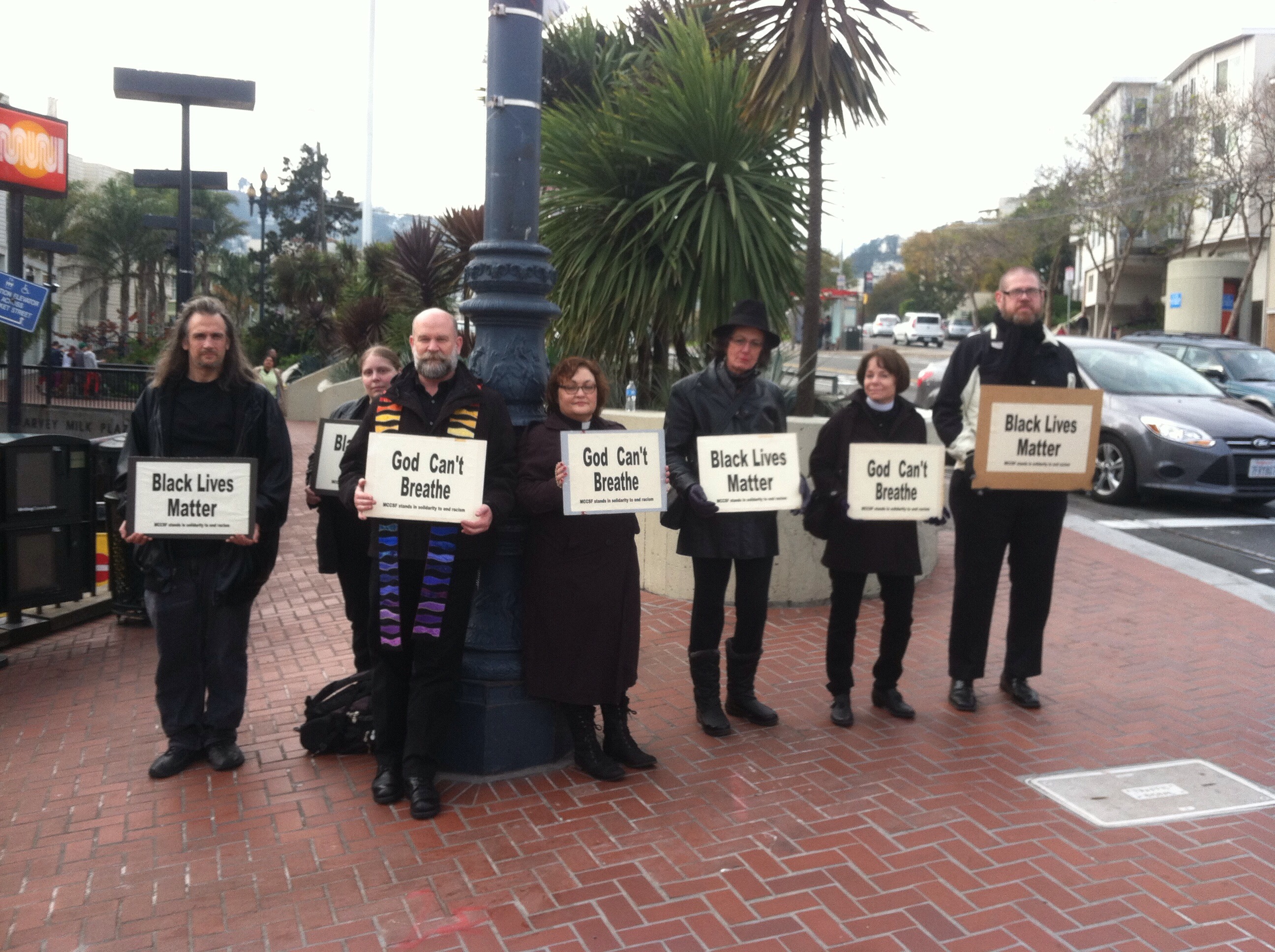
Participating in our (MCCSF) weekly silent protest on Castro & Market Street in solidarity to end racism provided me opportunities to see how much work we still need to do in a ‘Post-Racism’ America. I understand that I carry with me social privilege from being born white and male. My privilege continues to increase due to living in the United States, holding two undergraduate degrees, and one graduate degree. Being a Veteran also adds to my privilege.

2015/01/img_1827.jpg

When others begin to look at the marginalized aspects of my life, this is where I begin to lose some of my privilege. Being an out member of the LGBTQI community, I become part of a subsection of our society that is not afforded the same rights as heterosexuals in many parts of this country. Either through employment or housing discrimination and marriage equality to name but a few. Even being within this marginalize community, I still have my privilege of being a white male as I walk through a world of queers and strangers each day.

We have seen in the news over the last couple of years where businesses have refused to provide services to LGBTQI people. It wasn’t so long ago when Black Americans were refused services by businesses, seats on public transportation, as well as employment and housing opportunities to name a few.

The systematic incarceration of young Black men in this country has been equated to the new Jim Crow laws. This devaluation of human life, as well as the separation of the beloved from their families continues to be exacerbated by the deaths of innocence and unarmed young Black man.

Just as the white men stood with the leaders of the civil rights movement, I believe it is essential that I must stand up and speak out against the onslaught being perpetrated against men of color by law-enforcement. I encourage other clergy and men like me to stand in protest as well because #BlackLivesMatter.