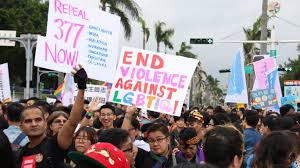
Excerpt from my paper: Examining the Impact of Anti-LGBTQ State-Sanctioned Violence on LGBTQ Young Adults and Responses in Scholarship to that Impact – A Review of Literature

Introduction
Culture affects how we view sex, and the ‘normalization’ of heterosexuality promotes a socially preferred performance of sexuality (Tonstad, 2018). A commonly held belief by many is that each person they meet is heterosexual – until proven otherwise. The sexual phobias of the few affect the sexual freedom of the many. This enforcement of heteronormative values upon sexual minorities has caused extensive damage to the emotional and spiritual health of the LGBTQ community. Bjork-James (2019) contends that we see conservative Christians coming from a perceived place of moral obligation to inflict state-sanctioned violence (SSV) which in turn fosters an environment that is unsafe and demeaning for the perceived sinful practices of LGBTQ individuals.
State-Sanctioned Violence
The proliferation of anti-LGBTQ state legislation can be seen as a form of SSV where the actions or inactions of a government agency or institution that either sanctions or ignores a population can have a negative impact. Bjork-James (2019) argues that white evangelicals have been working to oppose any LGBTQ rights since the 1970s with justification for this form of oppression being disguised as enforcement of morality, adhering to biblical teachings and not about hate. Bjork-James (2019) argues that conservative Christians claim no wrongdoing in their anti-LGBTQ actions, and they falsely expound their own victimhood due to the increase of civil rights for sexual minorities. Bjork-James (2019) points out that conservative Christians are defending these methods used to maintain a doctrine of heteronormativity by claiming their “criticism of LGBTQ rights is not rooted in personal animus” (p. 281). Bjork-James (2019) contends that conservative Christians’ imperative to maintain moral order in the United States comes from a false notion the country was founded as a Christian nation. As during the time of Anita Bryant, conservative Christians are justifying the increase in SSV today under the guise of ‘saving the children’ from the “homosexual agenda” (Bjork-James, 2019, p. 278).
Over the past decade numerous conservative state legislatures have debated and proposed numerous anti-LGBTQ bills. While many of these bills did not become law for various reasons, the fact they were debated can be seen as a form of SSV in how it affected the LGBTQ community. Cunningham et al. (2022) examine the relationship between anti-transgender rights legislation in state legislatures and the increase in internet searches related to suicide and depression. The article illustrates how an anti-transgender bill in Texas was only debated in committee and had a profound impact on the transgender community. While this bill was never voted on the floor of the Texas House, “reports from a suicide hotline indicate an almost doubling of calls from transgender youth during [that] time” (Cunningham et al., 2022, p. 2). The qualitative research Cunningham et al. (2022) discuss illustrates there is a correlation between the passage or defeat of anti-transgender legislation and the increase of suicide-related searches or decrease in depression-related searches, respectfully.
The systemic nature of SSV has an impact on the larger LGBTQ community as well as individual members. The systemic attacks upon LGBTQ rights we are currently seeing in various part of the United States has increased the potential for individuals to experience violence, including death. Lund et al. (2021) illustrate the implicit and explicit violence perpetrated against members of the greater LGBTQ community, that is viewed as interpersonal and systemic violence, respectfully. Gebhard et al. (2022) “define [SSV] as government entities’ use of violence to control or punish; those entities’ turning a blind eye to violence; and criminal prosecution of those who attempt to defend themselves through intimidation, fear and threat to life” (p. 476). Gebhard et al. (2022) primarily focus on community resiliency in the face of SSV and illustrate how systemic oppression “has been a fixture of the country since its beginnings” (p. 476). Creating stigma of ‘the other’ helps to enlist support to perpetuate SSV from the dominant population. This support of ‘othering’ can also lead to the engagement of individuals to perpetuate this violence towards LGBTQ individuals.
Cunningham et al. (2022) argue that conservative Christians use an illusion of being in the majority with power to inflict SSV through enactment of policies, legislation, and laws to maintain their constant message for the oppression, rejection, and stigmatization of LGBTQ people. Having one’s senses inundated daily that others see them as disgusting, as an abomination, or as a threat to society will have a negative impact, especially if that individual is a religiously-affiliated member of the LGBTQ community. Believing to be morally defective with feelings of guilt or shame about not living up to the higher standards of one’s family or community can begin to elicit an internalized tension that can become a spiritual struggle or religious trauma (Pargament, 2021).
___________________________________________________
Bibliography
Bjork-James, S. (2019). Christian Nationalism and LGBTQ Structural Violence in the United States. Journal of Religion and Violence, 7(3), 278–302. https://doi.org/10.5840/jrv202031069
Cunningham, G. B., Watanabe, N. M., & Buzuvis, E. (2022). Anti-transgender rights legislation and internet searches pertaining to depression and suicide. PLoS One, 17(12), e0279420. https://doi.org/10.1371/journal.pone.0279420
Gebhard, K. T., Hargrove, S., Chaudhry, T., Buchwach, S. Y., & Cattaneo, L. B. (2022). Building strength for the long haul toward liberation: What psychology can contribute to the resilience of communities targeted by state‐sanctioned violence. American Journal of Community Psychology, 70(3–4), 475–492. https://doi.org/10.1002/ajcp.12596
Pargament, K. I. (2021). Introducing Spiritual Struggles. In Working with spiritual struggles in psychotherapy: From research to practice (pp. 3–24). Guilford Publications. Tonstad, L. M. (2018). Queer Theory: Beyond Apologetics. Cascade Books.


 Leave Shame Behind